Accelerate Your Move to a High Performance 48V Power Delivery Network
As power demands continue to rise across industries including telecommunications, high-performance computing, automotive, and industrial markets, engineers are increasingly turning to 48V power delivery networks (PDNs) as the architecture of choice. Compared to legacy 12V systems, 48V PDNs reduce conduction losses by 16x, enabling smaller form factors, improved thermal management, and greater overall system efficiency. This eBook explores the evolution of 48V adoption, outlines 15 technical challenges designers must address, and showcases real-world case studies demonstrating successful 48V PDN implementations. Leveraging purpose-built, high-performance power modules, engineers can rapidly prototype and deploy scalable 48V solutions that future-proof their designs.
In this guide, you'll explore
- 48V PDNs reduce I²R conduction losses by 16x compared to 12V systems, enabling thinner wiring, lighter cables, and lower heat dissipation.
- Industries including telecommunications, high-performance computing, automotive, and industrial automation are rapidly adopting 48V architectures for improved efficiency and scalability.
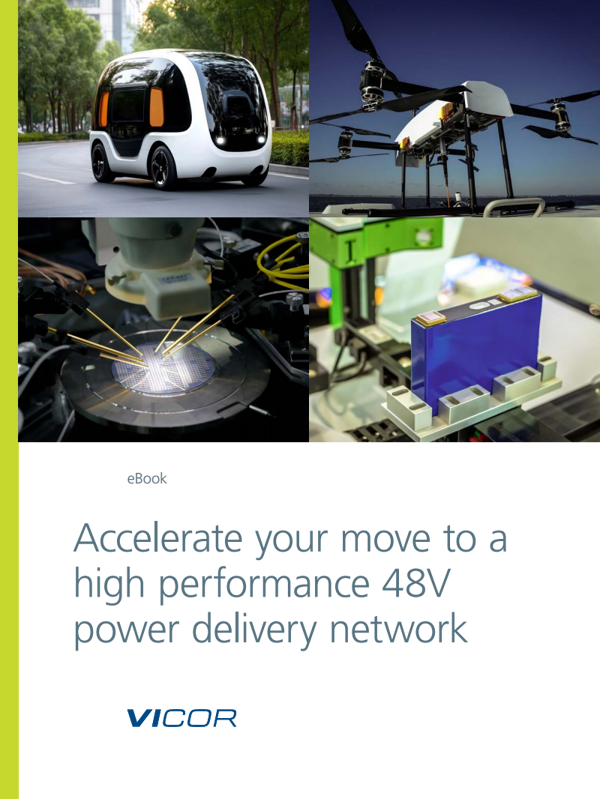
- Real-world case studies cover autonomous electric shuttles, tethered drones, remotely operated vehicles (ROVs), and battery testing systems that have successfully implemented 48V PDNs.
- High-performance, modular power components simplify the transition from 12V to 48V by offering high power density, electrical isolation, and optimized thermal packaging.
- A three-element 48V ecosystem framework—high-voltage to 48V conversion, point-of-load delivery, and 48V-to-12V bridging—enables engineers to design end-to-end scalable power architectures.